Showing posts with label travel. Show all posts

Wednesday, March 16, 2016

TRAVEL

Snake River


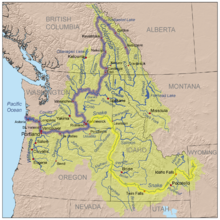
The Snake River is a major river of the greater Pacific Northwest in the United States. At 1,078 miles (1,735 km) long, it is the largest tributary of the Columbia River, the largest North American river that empties into the Pacific Ocean.[9] Rising in westernWyoming, the river flows through the Snake River Plain of southern Idaho then through the rugged Hells Canyon area via northeastern Oregon and the rolling Palouse Hills to reach its mouth near the Washington Tri-Cities area, where it continues as part of the Columbia. Its drainage basin encompasses parts of six U.S. states, and its average discharge is over 54,000 cubic feet per second (1,500 m3/s).
Rugged mountains divided by rolling plains characterize the physiographically diverse watershed of the Snake River. The Snake River Plain was created by a volcanic hotspot which now lies underneath Yellowstone National Park, the headwaters of the Snake River. Gigantic glacial-retreat flooding episodes that occurred during the previous Ice Age carved out many topographical features including various canyons and ridges along the middle and lower Snake. Two of these catastrophic flooding events significantly affected the river and its surrounds.
More than 11,000 years ago, prehistoric Native Americans lived along the Snake. Salmon from the Pacific Ocean spawned in the millions in the river. These fish were central to the lives of the people along the Snake below Shoshone Falls. By the time Lewis and Clark crossed the Rockies and sighted the valley of a Snake tributary, the Nez Perce and Shoshone were the most powerful people in the region. Contact with Europeans introduced horses to some tribes, reshaping their lifestyles for the next few hundred years before outside settlement. Later explorers and fur trappers further changed and used the resources of the Snake River basin. At one point, a hand sign made by the Shoshones representing fish was misinterpreted to represent a snake, giving the Snake River its name.
By the middle 19th century, the Oregon Trail, a pioneer trail of which a major portion followed the Snake River, had been established.Steamboats and railroads moved agricultural products and minerals along the river throughout the 19th and early 20th centuries. The powerful, steep flow of the Snake River has been utilized since the 1890s to generate hydroelectricity, enhance navigation and provide irrigation water from fifteen major dams that have transformed the lower river into a series of reservoirs, several of which have been proposed for removal to restore some of the river's once-tremendous salmon runs.
Brought to you by:  http://coffeeganoderm.blogspot.com
From: wikipedia.org

Saturday, March 12, 2016

TRAVEL

VAIL, COLORADO
WINTER SKI TOWN USA & SUMMER MOUTAIN HIKE & BIKE TOWN USA


Vail was incorporated in 1966, four years after the opening of Vail Ski Resort. The ski area was founded by Pete Seibert and local rancher Earl Eaton in 1962, at the base of Vail Pass. The pass was named after Charles Vail, the highway engineer who routed U.S. Highway 6 through the Vail Valley in 1940, which eventually became Interstate 70. Seibert, a New England native, served in the U.S. Army's 10th Mountain Division during World War II, which trained at Camp Hale, 14 miles south of Vail between Red Cliff and Leadville. He was wounded in Italy at the Battle of Riva Ridge but went on to become a professional skier after he recovered.[6]
Seibert, with other former members of the 10th Mountain Division, returned to Colorado after World War II with the intention of opening a ski resort. During training for ski troopers at Camp Hale, he bivouacked on Vail Mountain and identified it as an ideal ski mountain. In the early 1960s, Seibert raised funds from a group of Denver investors, including Jack Tweedy, and with Earl Eaton bought a ranch at the base of the mountain and eventually incorporated as Vail Associates. As plans continued for a new ski resort, Seibert hired Morrie Shepard as Vail's first ski school director. Shortly after, Shepard recruited Rod Slifer from Aspen to be assistant ski school director. Slifer also became the only real estate broker in the early years of Vail and would later be the broker in the transaction that allowed Vail to buy a ranch, now known as the world famous Beaver Creek.
In December 1962 Vail officially opened for its first season. It operated a gondola lift and two ski lifts on the mountain owned by the United States Forest Service. The village was established at the base of the mountain for local residents and offered lodging for visitors. It quickly grew throughout the valley with housing added first in East Vail and then West Vail, and additional lodging added in Lionshead in the late 1960s.[6][7] Within the first years the village had a ski shop operated by John Houserman, a hotel and restaurant operated by Pepi Gramshammer, and the mountain had a manager.[8] By 1969 Vail was the most popular ski resort in the state. In 1988 Vail opened China Bowl, making Vail the largest ski area in North America.
Brought to you by: http://coffeeganoderm.blogspot.com/
Post: Wikipedia

Friday, March 11, 2016

TRAVEL

Westward Ho in Seattle

Channeling Wes Anderson’s The Life Aquatic mixed with a dash of vintage yacht club, chef Josh Henderson and designer Matthew Parker of the Huxley Wallace Collective have created Westward, a restaurant and oyster bar on Seattle’s Lake Union with views across the water to downtown. The duo relied on a coterie of local designers to finesse the nautical notes. 


Westward-restaurant-Seattle-dining-room-Remodelista


Westward-restaurant-Little-Gull-metal-bar-Seattle-Remodelista


Westward-restaurant-Seattle-dock-Remodelista


Westward-restaurant-Seattle-shelving-Remodelista